Soy. History, Benefits, and Biochemistry
Category: plants Date (published): 07-03-2026 10:28;
 (0)
(0) Soy, scorched by the blazing sun, is one of the most ancient crops of world agriculture. It has traveled a long path from a modest wild plant to one of the most valuable cultivated crops.

Soybean seeds of different varieties.
Wild soy bears little resemblance to its cultivated descendants. It is an unprepossessing annual herbaceous plant with an upright or twining, branching stem. The leaves are compound, trifoliate. The flowers are very small, pale violet, gathered in short axillary racemes. The fruits are small pods, dark gray, almost black, slightly curved, containing very small seeds, from one to five in number. When ripe, the pods split open and the seeds are scattered up to three meters away.
It has been established that the primary genetic center of wild soy is located in the territory of Northern China, the island of Taiwan, the Korean Peninsula, and the Russian Far East. From this main global center of origin, the initial forms of all cultivated soybean varieties originate.
Modern cultivated soybean varieties typically bear 100–150 pods that do not shatter. The large seeds mature 80–100 days after planting. Until the 20th century, varieties with black, green, brown, yellowish-green, or mottled seeds were distributed worldwide. Today, varieties with straw-yellow seeds predominate.

Soybean. Drawing from the Japanese agricultural encyclopedia Seikei Zusetsu, 1804. Leiden University Library.
The name of soy in all European languages (soy, soya, soja) originally referred to food products, not the plant. This happened because Europeans first became acquainted not with the plant itself, but with the exotic food prepared from soy seeds.
The Dutch origin of the word “soja” is supported by the fact that from 1609, the Dutch were the only Europeans who succeeded in establishing reliable, long-term trade relations with Japan.
From the Dutch language, the word soja passed into all European languages, eventually becoming the name of the plant itself. Today in Russian and most European languages, soy seeds in trade, cooking, and literature are often called soybeans — from the English “soya beans.” In this regard, the author deemed it appropriate to remind curious readers that beans are the botanical morphological name for the fruits of soy, containing the very seeds for which this leguminous crop is grown worldwide.
The botanical name of the plant has undergone numerous changes. In 1753, Carl Linnaeus gave it the name Dolichos soya. In 1794, the German professor of botany at the University of Marburg, Conrad Moench, decided that the plant, covered in hairs, deserved the name Soja hispida — bristly soy.
In Russia, the naturalist and explorer of Siberia and the Far East R. K. Maack (1825–1886) and the botanist E. L. Regel (1815–1892), who studied the flora of the Ussuri region, Eastern Siberia, and Sakhalin, in their works called wild soy Glycine soja. In 1873, the botanist and researcher of the flora of the Far East and Japan, C. J. Maximowicz (1827–1891), proposed calling wild soy Glycine hispida.
By the end of the 19th century, taxonomic confusion had reached its limit. At least four systematic names were being used simultaneously for soy. Attempts to end this were made with the help of cytological and genetic studies carried out in the 1960s and 1970s in different countries. The result was a proposal adopted at a botanical congress to name cultivated soy Glycine max — cultivated soybean, and its wild ancestor Glycine soya or Glycine max subsp. soya.
Soy was turned into a cultivated plant presumably no less than 6–7 thousand years ago. By the 1st century AD, soy was already grown throughout China, and wars and trade allowed it to move to Korea and Japan. In all these countries, vegetable oil was extracted from its seeds, and natural and fermented food products were made.
In Europe, soy initially appeared in the botanical gardens of the Netherlands (1737), France (1739), and England (1779). In 1821, the first attempts to sow and grow cultivated soy were made in France. In North America, soy began to be cultivated in the second half of the 18th century.
In Russia, the first mention of soy growing in the Far East, in the middle reaches of the Amur River, and the consumption of its seeds as food by the local population appears in the account of the 17th-century Russian explorer V. D. Poyarkov, compiled by him in 1646 following a journey to the lands adjacent to the Amur River. Among various pieces of information, Poyarkov reported that among the tribes inhabiting the banks of the Amur, “beans” predominated in their diet over other grain crops. This was how, in the Amur region at that time, they referred to the soy seeds used by the local peoples for preparing food.

Cleaning soybean seeds. Amur Soybean Experimental Station. 1927.
The information obtained by Poyarkov had little influence on the subsequent fate of soy, and until the first quarter of the 20th century in Russia, the use of the seeds was limited to obtaining edible oil and oilcake for livestock feed.
Modern soybean varieties are characterized by variability in seed size and chemical composition. This primarily concerns the content of proteins (up to 40%), fatty oil (18–20%), and carbohydrates (up to 20%). Complex processing of the seeds makes it possible to obtain high-quality vegetable oil, protein food products, soy flour for the baking and confectionery industries, and oilcake for the production of feed for animals and poultry.
Soybean seeds are distinguished by the highest protein content among the main grain crops, which can easily be seen by looking at the table.
Average Protein Content (in grams) per 100 g of Grain Crops
| Soybean | Kidney beans | Pea | Corn | Wheat | Rice | Sunflower |
| 36 | 22 | 8 | 10 | 4 | 7 | 20 |
In the modern food industry, soybean seeds primarily serve as a relatively cheap source of vegetable protein, which is added to sausages, frankfurters, wieners, meat semi-finished products, salad dressings, sauces, etc. Lecithin obtained from soybean oil is widely used as an emulsifier.
In the confectionery industry, soy serves as a substitute for expensive nut, dairy, and other traditional confectionery raw materials. As a result, finished products become cheaper and less caloric while retaining their main taste qualities. Defatted and full-fat soy flour are used for the production of confectionery items. Full-fat soy flour is made from roasted soybeans. In addition to protein, it contains natural vegetable oil and carbohydrates. Defatted soy flour is produced from soybeans after the oil has been removed from them.
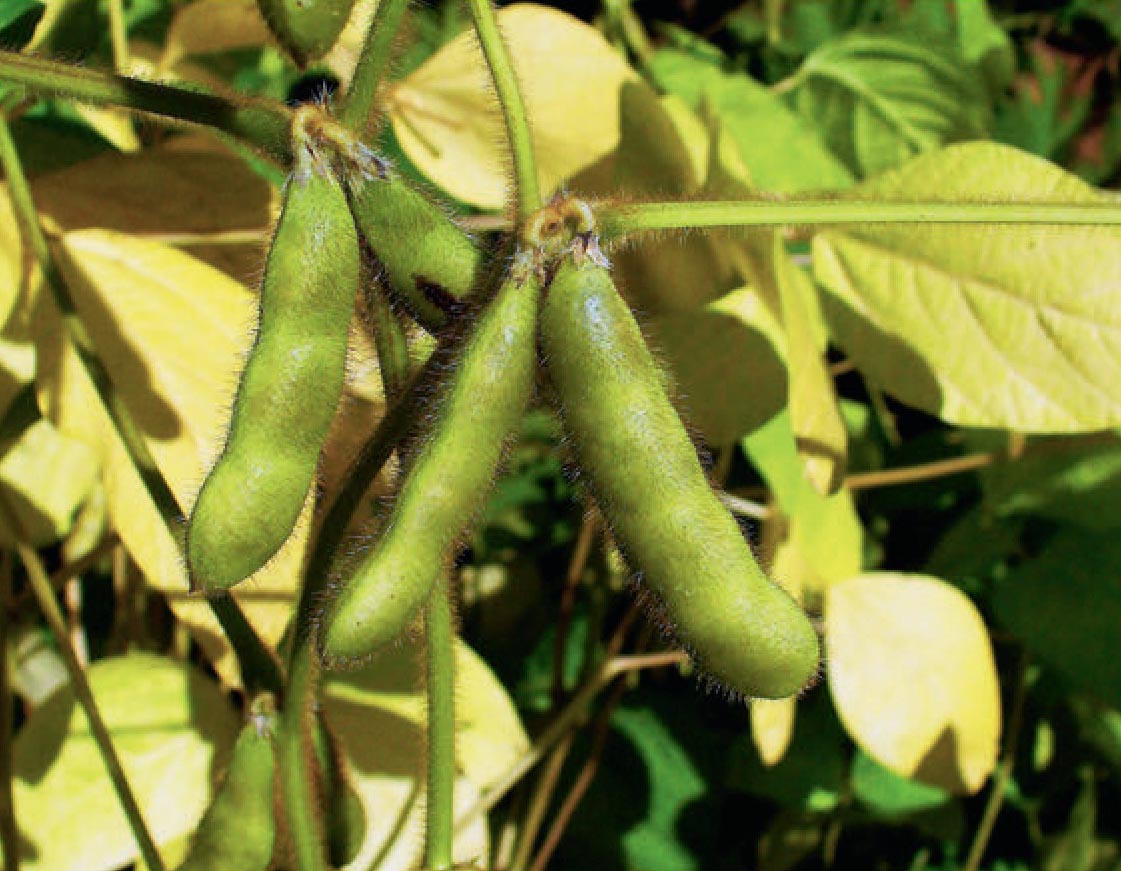
Soybeans.
Full-fat soy flour is added in place of nut raw materials in amounts ranging from 5 to 30% in the production of praline, fondant, fruit, and cream-filled candies, caramel fillings, toffees, dragees, halva, chocolate, cookies, wafers, and fat-based glazes. In the USA, Japan, and some European countries, popular nut pastes are produced with the addition of that same full-fat soy flour.
In the assortment of food products familiar to us, soy culinary items originating from the countries of Southeast Asia are increasingly appearing. The best known of these are soy sauce, soy milk, tofu, and miso.

Tofu, or soy curd.
Soy milk is a water extract of soybean seeds. The earliest written mention of it in China is associated with the making of tofu and is found in the “Critical Essays” (circa 82 AD) by the philosopher and encyclopedist Wang Chong. The basic Chinese method of preparing soy milk consisted of grinding soy seeds swollen in water using a hand mill with stone millstones, adding a small amount of cold water until a thick puree was obtained; this was then diluted with cold water, mixed, placed on a bamboo sieve lined with cloth, and allowed the soy milk to filter through. The residue on the cloth was rinsed with cold water and pressed. The resulting soy milk was boiled for 10–20 minutes.
At the beginning of the 20th century, soy milk began to be mass-produced in China as a cheap beverage. Around the same time, scientific interest in this product arose in the Western world. As a result, in the early 1970s, a technology for manufacturing soy milk was developed that made it possible to eliminate its peculiar odor and so-called beany flavor, which had been the main obstacle to the spread of soy milk beyond China.
In the Soviet Union, attempts were made to introduce soy milk as a substitute for natural milk in the 1930s, but genuine interest in it emerged only among vegetarians and vegans.
Soy milk is primarily used for preparing tofu, or “soy curd.” In China, the creation of tofu is attributed to the Chinese prince Liu An (179–122 BC), who was passionate about the ideas of Daoism and Confucianism. Having conceived the idea of creating an elixir of immortality, he went into the mountains to realize his dream in solitude. The attempt to produce a miraculous means of eternal life was not crowned with success. Instead, from a mixture of soy milk and gypsum (CaSO₄·2H₂O) obtained from a nearby mountain, he obtained tofu. The taste of the newly appeared product pleased the prince himself, his entourage, and later the inhabitants of the Celestial Empire. When tofu became known in Japan, they began to use “nigari” (MgCl₂·nH₂O), obtained from seawater, to curdle the soy milk.
Both of these coagulants are still used in the traditional method of making tofu. Under the influence of calcium sulfate, a denser Chinese tofu is obtained, the consistency and taste of which are preferred by European enthusiasts of Chinese cuisine. Magnesium chloride gives Japanese tofu a more delicate consistency.
Modern tofu, as before, is prepared by adding mineral coagulants to concentrated soy milk. The resulting curd mass is separated from the liquid and given one shape or another. Simple to make and comparatively inexpensive, tofu has become part of the culinary tradition of China, Korea, Japan, and all of Southeast Asia. In the mid-1980s, its taste became known in Europe, and somewhat later it was introduced to Russia.
Comparative Characteristics of the Nutritional and Energy Value of 100 g of Soy Products (Average Values in Grams)
| Nutrients | Soy Milk | Tofu | Miso | Soy Sauce |
| Water | 88.0 | 5.0 | 43.0 | 71.0 |
| Proteins | 3.0 | 12.0 | 13.0 | 8.0 |
| Fats | 2.0 | 4.0 | 6.0 | 1.0 |
| Carbohydrates | 6.0 | 6.0 | 25.0 | 5.0 |
| Minerals | 1.0 | 2.0 | 12.0 | 15.0 |
| Caloric content, kcal | 54 | 70 | 198 | 53 |
Tofu does not possess an expressive taste or smell. It can be soft, firm, hard, and even dry. In any state, tofu is capable of readily acquiring new flavors and aromas from spices, sauces, and marinades. It can be eaten raw directly, boiled, stewed, pan-fried, grilled, or deep-fried. Thanks to this quality and its nutritional value, tofu has recently become a popular product capable of adding variety to the meager menus of vegetarians and vegans.
Another soy product is miso: this is a Japanese thick paste obtained by fermenting soybeans in the presence of a koji starter, sea salt, and water. Some varieties of miso are prepared from a mixture of soybeans, rice, wheat, or barley. Fermentation occurs under the influence of enzymes secreted by the mold Aspergillus oryzae. After mixing all the ingredients in special containers, the contents undergo fermentation from several months to two years. The result is a paste-like mass, the taste of which is described in Japan as salty, sweet, earthy, umami (“pleasant taste”), and kokumi (“rich taste”). In the opinion of Japanese miso lovers, the combination of the four basic and two additional tastes allows one to derive true pleasure from this food.
The renowned Russian navigator V. M. Golovnin (1776–1831) and his sailors came to know the taste of miso while imprisoned in Japan, as he recounted in “Notes of Fleet Captain Golovnin on His Adventures in Captivity with the Japanese”: “We were fed three times a day: in the morning, at noon, and in the evening; the food consisted of a thick porridge made of rice instead of bread… Along with the porridge we were given a soup of seaweed or some wild greens, such as hogweed (Heracleum nipponicum Kitag.), ramson, or angelica (Angelica acutiloba Kitag.), mixing into it for taste some fermented beans, called misso in Japanese, to which a few pieces of whale blubber were sometimes added…”
Miso paste is used as a base for various Japanese soups or to enhance the flavor of many dishes. In Japan, miso is considered a food beneficial for health, capable of improving digestion and increasing the body’s resistance to diseases. All other healing properties attributed to miso lack scientifically substantiated proof.
In the Western world, miso is still regarded as an exotic product of Japanese cuisine that is of interest only to lovers of peculiar taste sensations.
Soy sauce, soy milk, miso, and tofu in the countries of Southeast Asia are considered food created for the sake of deriving pleasure, without burdening oneself with thoughts about the presence or absence of benefit.
In the global food basket, soy food products are intended to improve the protein and lipid composition of the diet. Unfortunately, distrust regarding their beneficial properties still exists. To some extent, the Internet and mass media are to blame for this, spreading unreliable or “sensational” information about soy. The majority of the population draws dubious knowledge about healthy eating and food quality precisely from there, whereas true information capable of forming correct notions about the benefits or harms of consumed products in general, and those made from soybeans in particular, rests on the pages of scarcely accessible scientific journals and books. The author hopes that curious and sensible readers are capable of finding the golden mean between unbridled praise of soy products and their complete rejection. In Russia, despite the fact that, as stated in “The Golden Calf,” “pedestrians … have established that 114 tasty, nutritious dishes can be made from soybeans,” these dishes have still not yet taken the worthy place in the everyday home menus of citizens that they deserve. The author has no doubt that the opposite will happen sooner or later.
Soy Cookery
Recipes for tasty, wholesome, and easy-to-make soy dishes for a wide circle of readers. They may appeal not only to vegetarians and vegans, but to all lovers of good food.
Miso Soup

Miso soup.
Miso soup, popular in Japan, is made from dashi broth, miso paste, tofu, and vegetables. Dashi is a Japanese broth used to prepare a variety of soups, sauces, and other dishes. It can be made from shiitake mushrooms, seaweed, or dried fish. All of these are sold as liquid or dry concentrate, which is diluted with water before use.
To prepare miso soup, place sliced onion into boiling dashi, cook for 5 minutes, add diced tofu, cook for a few minutes while stirring, then dissolve miso paste in the soup and serve immediately in a deep bowl, sprinkled with green onion.
Note: For a European version of vegetarian miso soup, any vegetable broth prepared in advance can be used.
Miso diluted with water can be used as a flavoring addition to a wide variety of vegetarian soups, stews, sauces, and marinades for vegetables intended for deep-frying. Miso is always added at the end of cooking, because the longer it is heated, the more its flavor is lost.
Crispy Tofu
Crispy tofu is easy to prepare and surprisingly simple to turn from a bland product into a piquant vegetarian snack, side dish, or flavor addition to various dishes.
400 g tofu, for the coating: 100 g (3 tbsp) corn or wheat flour, 5 g (1/2 tsp) smoked paprika, 5 g (1/2 tsp) garlic granules, 5 g (1/2 tsp) fine salt, 5 g (1/2 tsp) ground red pepper. Vegetable oil.
Wrap the tofu in 4–5 paper towels, place under a heavy wooden cutting board or a weighted tray for 20–30 minutes to remove excess moisture.
Mix all the coating ingredients in a bowl. Cut the tofu in half into two flat pieces, then cut into triangles, cubes, or strips, and toss in the coating mixture. Place in portions in a single layer in a frying pan with vegetable oil heated over medium heat, fry the tofu for 2–4 minutes on each side until a crispy golden-brown crust appears. Place the cooked tofu on a paper towel, season with a small pinch of salt, and serve as a snack or side dish for a vegetarian feast.
Noodles with Crispy Tofu
The combination of crispy tofu with noodles, broccoli, green peas, and spices in a moderately spicy, appetizing dish will undoubtedly appeal to vegans, vegetarians, and ordinary lovers of Eastern cuisine alike.
400 g tofu, 250 g medium egg noodles, 20 ml (1 tbsp) vegetable oil, 2 white parts of green onions, sliced, half a large head of broccoli, finely chopped, 200 g canned green peas, 50 ml (2 tbsp) light soy sauce, 5 g (1 tsp) finely grated ginger, 3 cloves of garlic, finely grated, 5 g (1 tsp) hot red pepper, juice of 1 lemon, 5 g (1 tsp) Chinese five-spice blend (cinnamon, fennel, star anise, Sichuan pepper, and cloves), a small bunch of cilantro.
Note: instead of the Chinese five-spice blend, which is rare in our shops, you can use ready-made seasonings — herbes de Provence or Italian herbs. The dish will become more European, but no less tasty.
Prepare the crispy tofu as in the previous recipe.
Boil the noodles according to the package instructions, drain in a colander, rinse with cold water so they do not stick together.
In a large frying pan, heat the oil over high heat, sauté the ginger and garlic in it for 2–3 minutes, add the Chinese or European seasoning, stir, add the broccoli and green peas. Stirring regularly, cook for 10–12 minutes, add the cooked noodles, soy sauce, chopped cilantro, pour in half the lemon juice, mixing with two wooden spoons, and heat through for a few minutes. Toss the crispy tofu with the other half of the lemon juice. Divide the noodles among four plates, top with the crispy tofu.
Korean Crispy Tofu Salad with Honey-Soy Chili Dressing
A tasty and aromatic light salad in a fashionable Korean style, from which readers who avoid heavy meat dishes will derive true enjoyment of flavor and benefit for health.
350 g crispy tofu, 25–30 g soybean sprouts (or sprouts of beans, peas, lentils, or any other sprouts), 10 g (1 tbsp) toasted sesame seeds.
Dressing: 20 ml (1 tbsp) soy sauce, 20 ml (1 tbsp) apple cider vinegar (or any natural vinegar), 20 ml (1 tbsp) honey, 20 ml (1 tbsp) lemon juice, 10 ml (1 tsp) sesame oil, 1–2 g (1/2–1 tsp) red chili pepper.
Prepare the crispy tofu as in the first recipe.
Place all the dressing ingredients in a deep bowl and mix thoroughly until a homogeneous consistency is obtained.
On a serving platter, beautifully arrange the sprouts, on top of them carefully, using a spoon, place the crispy tofu, sprinkle evenly with sesame seeds, carefully drizzle the entire salad with the dressing, and serve.
Note: This salad should be prepared just before you set out to enjoy its taste.
Chemistry
The physiological requirement for protein for the adult population is from 65 to 117 g/day for men and from 58 to 87 g/day for women. It is desirable that one half be of animal origin and the other of plant origin. Dietitians assert that in the absence of sources of animal protein, consuming food containing 150–250 g of soy products can temporarily satisfy the daily requirement of an adult for the majority of amino acids. For comparison: approximately 3–5 times more cereal grain seeds would be needed for this. Using a mixture of soy and cereal grain seeds for the production of food products allows their biological value to be significantly increased. At the same time, the absence in soy protein of several vital amino acids, contrary to the widespread opinion among dietitians, does not allow it to be considered a full-fledged alternative to animal protein.
The share of soybean oil in the world production of vegetable oils is about 33%. It consists of triglycerides of higher monounsaturated (24%), polyunsaturated (59%), and saturated (14%) fatty acids. The remainder is made up of free fatty acids, phospholipids, and phytosterols.
The fairly high content of unsaturated fatty acids, considered beneficial, imparts to the oil the ability to turn rancid upon long-term storage.
Soybean oil phospholipids are triglycerides of fatty acids that contain phosphorus. In the human body, they participate in lipid metabolism, preventing the development of atherosclerosis, improving the intellectual work of the brain, and helping to preserve memory. With a deficiency of phospholipids, fat-soluble vitamins are poorly absorbed, pancreatic function deteriorates, interest in the opposite sex decreases, and, as a consequence, the ability to bear children.
Unrefined, cold-pressed soybean oil of a brown color with a greenish tint contains on average about 2% phospholipids. For comparison: the same amount of sunflower oil contains about 1%. The taste and smell of natural unrefined soybean oil, which in culinary literature are modestly called specific, the majority of European inhabitants are inclined to consider unpleasant. The author’s attempt to dress with it a salad of appetizing crispy sauerkraut ended sadly not for the author, but for the salad, which, despite all the benefits ascribed to it, had to be thrown away. A salad dressed with light-yellow refined and deodorized soybean oil turned out to be edible, but, alas, the most beneficial phospholipids were practically absent in it.
In the total carbohydrates of soy seeds, besides fiber, pectins, starch, sucrose, glucose, and fructose, the trisaccharide raffinose and the tetrasaccharide stachyose are present, which contain the monosaccharide galactose. Due to the absence in the human small intestine of the enzyme galactosidase, these carbohydrates are not digested and, entering the large intestine, are partially or completely hydrolyzed by enzymes of the large intestine microflora, with the formation of an excessive amount of gas, causing such an undesirable and inconvenient phenomenon as flatulence. In home cooking, in order to reduce the process of gas formation, it is absolutely necessary to add aromatic spices (marjoram, oregano, caraway, dill, etc.) to dishes made from soy and other legumes. They will not only make the food appealing, but also, possessing a carminative effect, will reduce the unpleasant consequences of eaten soy dishes.
The fiber of soy seeds (cellulose, hemicellulose) stimulates intestinal peristalsis, and pectin substances help eliminate toxic metabolic products from the body.
Soy seeds contain the sum of vitamins, macro- and microelements, characteristic of the seeds of any leguminous crops and balanced by nature itself.
The chemical composition of soy seeds allows us to say that they possess high nutritional value. But there is no perfection in the world, nor is there any in soy. Soy seeds contain a number of protein components that dietitians call antinutritional. From a biochemical perspective, these are inhibitors of the enzyme trypsin, which hydrolyzes proteins and peptides, and lectins — proteins that influence the absorption of carbohydrates. These substances disrupt the normal digestion of food containing proteins and carbohydrates. In the seeds of soy and other legumes, their content ranges from 2 to 10% of the total protein. The carbohydrates stachyose and raffinose, which cause fermentation in the large intestine, are also classified as antinutritional substances of soy.
To reduce the negative impact of antinutritional substances on digestion, soy seeds are subjected to thermal or enzymatic treatment before consumption. In an alkaline medium, the softening of seeds and the destruction of antinutritional substances occur quite rapidly. This is the basis for the ancient intuitive culinary recommendation to boil all legume seeds in the presence of a small amount of baking soda.
Source: Candidate of Pharmaceutical Sciences Igor SOKOLSKY, Science and Life, 2026-1
Category:
plants 
Humanity has never given up on the dream of Martian gardens, and step by step, we are edging closer to that goal. One of those steps was a joint experiment by the D.I. Ivanovsky Academy of Biology and Medicine of the Southern Federal University (SFedU) and the Institute of Biomedical Problems of the Russian Academy of Sciences. Researchers assembled a consortium of ten microbial strains and sent them into near-Earth orbit aboard the Bion-M No. 2 spacecraft. Their aim: to see how a complex community of bacteria and fungi withstands the extreme conditions of spaceflight — heightened radiation, weightlessness, and heavy g-forces. At the orbit of 370–380 km where Bion-M No. 2 flew, radiation levels are over 200 times higher than Earth’s natural background and 30% higher than aboard the International Space Station.
... Read more
Animal communication is studied not only to learn more about the animals themselves, but also to understand how human language originated. This refers, of course, to vocal communication: how it occurs, what neural mechanisms are involved in it, and what exactly is contained in the vocal messages animals exchange. In this regard, chimpanzees receive special attention — after all, from an evolutionary perspective, they are our closest relatives. The vocal signal repertoire of chimpanzees is quite broad, and within it, one can distinguish between simple and complex signals. But what does "complex signals" mean? Various animals, not just chimpanzees, combine sounds together, but it is usually thought that the resulting complexity is purely superficial, that the sounds are combined randomly. It has been shown for birds and primates that new meaning emerges in their sound combinations. However, this new meaning is also formed by simple addition, similar to how in the phrase "black cat" the new meaning arises from the simple combination of "black" and "cat."
... Read more Български
 Deutsch
 ქართული
 English
 Polski
 Română
 Русский
 Türkçe
 Suomi
Suomi Svenska
 Українська
